
Silverback Gorilla Tours
Walking With the Great Apes in their Natural Habitant
Visit Volcanoes National Park Rwanda
Silverback Gorilla Tour
A silverback gorilla tour is an ultimate once-in-a-lifetime experience that gets you up close and personal with the friendly, gentle giant apes in their natural environment. This activity involves hiking through the dense equatorial forests of East Africa to meet the magnificent human cousins with a focus on observing the dominating male, who is known as the silverback.
What is a silverback gorilla?
A silverback gorilla is a mature male gorilla. Gorillas live in groups known as families that are led by the dominant silverback.
A dominant silverback mountain gorilla can be recognized by its silvery hair covering its back. Dominant silverbacks are well-known for their aggressive and authoritative behaviours, such as charging, whooping, chest beating, tree slapping, and often, physical fighting, plus a remarkable show of maturity. Silverbacks control the family movements, feeding patterns, make decisions, mate with the females, and defend the family from both internal and external attacks.
A fully grown silverback weighs 430 pounds(195kgs) and stands at 5 feet (1.5m) and can lift over 1763 pounds (800kgs). Male gorillas mature into silverbacks at the age of 8- 14 years.

A young male gorilla that is out of the baby stage but not yet a silverback is referred to as the blackback. Blackbacks are always many in a gorilla family, but each family has only one silverback. A mature blackback will always want to take over leadership from the dominant silverback, but if it fails, it attempts to steal some females from the group to form another group.
The dominant silverback-female relationship
To increase their chances of having more offspring and prevent inbreeding, mature females frequently move between families. A female will try to establish a close relationship with the dominant silverback regardless of the family to which she belongs. This lessens the risk of anmity from unrelated females met through migration, which helps to control hostility from other males.
What do silverbacks feed on?
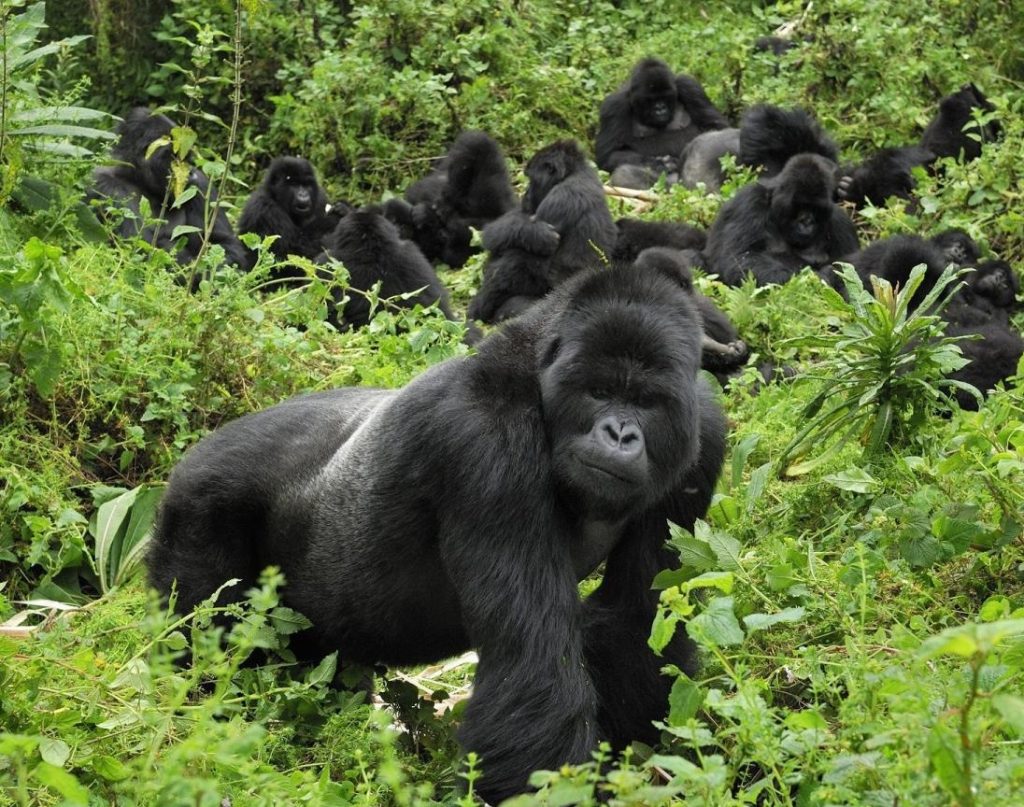
Silverback gorillas are herbivores, and their diet largely depends on what is in their natural habitat in a particular season of the year. Their food is mainly composed of green leaves, bamboo shoots, seeds, stems, flowers, tree barks, fruits, vines, roots, grasses, and your branches.
At times, they feed on soil to neutralize the poison found in some plants they eat and to also add some nutrients to their bodies. They also eat insects like ants, caterpillars, snails, and termites. They rarely drink water but can eat at least 30 kilograms of vegetation per day. The life span of a silverback gorilla is 40 to 50 years, depending on their feeding habits and health.
Where to go for silverback gorilla tours?
Meeting the silverback gorillas can be achieved when you visit any of the countries in Africa where gorillas are found and participate in the gorilla trekking or gorilla habituation activity. Many countries in East and Central Africa harbor gorillas, but we shall focus on East Africa. East Africa has both lowland and mountain gorillas. Bwindi Impenetrable National Park, Mgahinga National Park in Uganda, Volcanoes National Park in Rwanda, and Virunga National Park in DR Congo are the best for mountain gorilla tracking, yet Kahuzi Biega National Park in DR Congo offers eastern lowland gorilla trekking.
Are you planning to meet the silverback? Our experienced and knowledgeable staff from Active African vacations will help you organize a complete wildlife safari to any of the gorilla homes and offer a full tour package combined with activities like game drives, chimpanzee trekking, birding, nature walks, boat cruises, and mountain hiking.
How safe are silverback gorilla tours?
Gorilla tracking tours are considered a safe and risk-free activity due to the rules and regulations that were set up by the bodies that govern and monitor the tourism sector in the three countries that offer gorilla tracking, that is Uganda Wildlife Authority (UWA) in Uganda, Rwanda Development board (RDB) in Rwanda and Institut Congolais pour la Conservation de la Nature (ICCN).
Rules and regulations that help to govern the trekking exercise include obtaining a gorilla trekking permit, as the main necessity for one to engage in gorilla trekking. You must be 15 years and above, maintain 7 meters from the gorillas, avoid trekking when suffering from infectious diseases like flu and colds, do not use flash photography, avoid dumping in the park premises, and have the basic tracking gear among others.
Despite the large size, height, and strength of gorillas, they are considered calm, gentle, and peaceful. After the habituation process, which takes a year or two, they become used to human presence. If you follow the guidelines provided by the park rangers at the park center, you will have a successful trekking experience. Trekkers are always accompanied by armed game rangers. They help to protect the trekkers in case of encounters with dangerous animals like elephants or aggressive gorillas. They also help to control poachers and help to guide the trekkers.
Trekkers are allocated depending on their level of fitness and allowed to request the gorilla family they want to trek to. This relieves you of the hiking distance, though the time taken along the trek is unpredictable, as hikes always last from 30 minutes to six hours.
Rwanda and Uganda are very safe countries for both gorilla trekking and wildlife safaris. There is still some instability in some parts of DR Congo, but the gorilla parks of Kahuzi Biega and Virunga National Park are safe, and gorilla tracking can be done as per your schedule. Spend time with the lowland and mountain silverback gorillas, as the park management is ready to protect the gorillas and the tourists.
Recommended silverback gorilla tour packages
1 Day Rwanda Gorilla Trek
2 Day Rwanda Gorilla Trek
2 Days Rwanda Gorilla Trek And Bisoke Hiking
1 Day Rwanda Gorilla Trek
2 Day Rwanda Gorilla Trek
2 Days Rwanda Gorilla Trek And Bisoke Hiking
How to spend 4 days on a silverback gorilla safari in Uganda and Rwanda
As noted earlier that some of the world’s remaining gorilla species reside in Uganda and Rwanda. This 4 days safari will take you to two of the gorilla parks for the gorilla trekking and gorilla habituation experiences, where you will observe the silverback gorillas at a close range. The trip starts with a brief Kigali city tour, visit the genocide memorial sites, the bustling markets, and the art and craft centres. From the city, travel to Volcanoes National Park for the gorilla trekking, cross Rwanda Uganda border to Bwindi Impenetrable National Park for the gorilla habituation experience, where you will spend more time with the silverback gorilla.
Tour highlights
- Day 1: Arrival and transfer to Volcanoes National Park
- Day 2: Gorilla trekking and transfer to Bwindi Impenetrable National Park
- Day 3: Gorilla habituation in Rushaga sector
- Day 4: Return to Kigali and Departure
Day 1: Arrival and transfer to Volcanoes National Park
On the first day of your 4 days silverback gorilla safari, you will be met by a driver guide from Active African Vacations who will pick you up from the hotel /airport, brief you about the trip, and proceed to the city for a brief Kigali city tour. Visit the Kigali genocide memorial, the Convention Center, and Kimironko market. After lunch, transfer to Musanze as you enjoy the scenic rolling hills and valleys and the countryside. On arrival, check in at the lodge, have dinner, and overnight.
Day 2: Gorilla trekking and transfer to Bwindi Impenetrable National Park
Early in the morning, after an early breakfast, your driver guide will transfer you to Kinigi park center for a briefing from the RDB officials and later set off for the gorilla trekking activity. The gorilla trekking activity is a once- in – a lifetime adventure that will bring you close to the silverback and his family. Armed rangers will lead you into the park’s jungles to search for the gorillas. You will trek through varying terrain until you meet the gorilla family. stay in their company for one hour, take photos and videos, and then return to meet your driver. After lunch, check out and travel to Bwindi Impenetrable National Park in Uganda via Cyanika border. Connect to your accommodation in Rushaga, have dinner, and overnight
Day 3: Gorilla habituation
You will wake up early in the morning for breakfast, then drive to the park center for a briefing about the gorillas and how to behave during the gorilla habituation experience. Only 4 trekkers are allowed to participate in the habituation exercise on a single trek. You will be guided by armed rangers and researchers into the forest. During the trek, you will luckily spot other wildlife such as birds, mammals, and other primates. When you meet the gorilla family, you will be allowed to spend four hours with them. You will observe the gorillas as you listen to the researchers doing their work. At times, you may be called upon to participate in collecting samples and naming the group members. Capture photos and videos as much as you can. After the activity, return to the lodge for dinner and overnight.
Day 4: return to Kigali and departure
After breakfast, check out of the lodge and drive back to Kigali to your hotel or for your flight. Alternatively, you can depart through Entebbe airport in Uganda.
Cost of a gorilla permit
If you are planning to visit any of the gorilla tracking destinations, you must acquire a gorilla permit. A gorilla permit is a legal document that grants you quick access to the gorilla habitats. The cost varies per country. In Uganda, gorilla permits cost $800, in Rwanda $1500, and in Congo $450 per person per trek. Uganda offers the extraordinary gorilla habituation experience at $1500. Travelers are advised to book permits in advance, at least three months before the tracking date.
However, the cost of the gorilla permit does not cover additional expenses like transport, accommodation, porters, and souvenirs. With the gorilla tracking and habituation expeditions, you will fulfill your dream of spending some time with the calm human cousins that are always led by a dominant silverback.