
Busasamana caves in Rwanda
Busasamana caves, Rwanda a small country full of wonders is commonly referred to as the ‘land of a thousand hills’ is located in the eastern part of the black man’s continent, Africa. Rwanda is country full of natural and cultural wonders including the popular and hidden gems. From the bustling Kigali City, the sought-after home of mountain gorillas (Volcanoes National Park), the big five in Akagera National Park, the great chimps of Nyungwe and different cultural opportunities.
In Rwanda’s northern province lies a hidden treasure of 52 surveyed caves, most of which are as a result of Cenozoic volcanic rocks. The caves have passages covering 15.2 kilometers. And among the numerous caves is the Busasamana cave system.
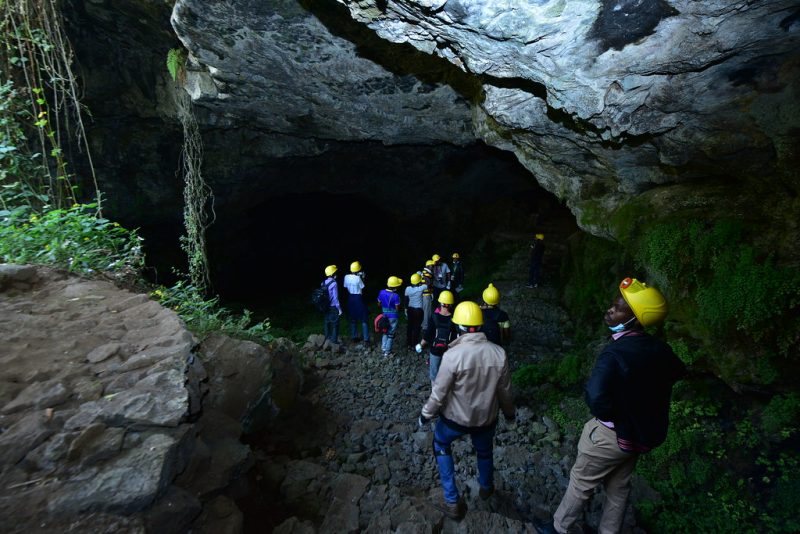
The Busasamana cave system is a geological marvel that acts as a link to Rwanda’s cultural past and an exhibit of tradition, folk tales and cultural practices. The Busasamana caves are result of volcanic activity that took place in the Virunga volcanoes over thousands of years. They were formed as a result of flowing molten lava carved hollow channels in the earth’s crust. With time, the lava tubes solidified leaving behind wide winding passages which are currently referred to as the Busasamana caves. The subterrene corridors in the caves are an amazing image and attraction of nature lovers and act as a true reflection of the virgin beauty of Africa’s wilderness.
The Busasamana caves are 1 kilometer long and connect to other caves in Busasamana, Mudende and Kasenze regions. The caves are one of the leas3t explored geological and cultural opportunities in Volcanoes National Park region and are sited approximately 4.9 miles from Rubavu – Musanze road close to Busasamana Catholic Parish.

Other caves that can be explored on Rwanda safari
Musanze caves: This is another tourists attraction in Musanze region. The Musanze caves are just 2 km from volcanoes National Park hence can be easily tailored to the gorilla trekking activity. Musanze caves are believed to have been formed by volcanic lava basaltic layers from Sabinyo and Bisoke volcanoes. The cave has a wide entrance and several small passageways leading off the main cave. The cave is also home to bats that care always seen hanging on the walls of the cave. The walls of the cave have beautifully growing vegetation so best for photography. The caves were used for refuge by many natives during the 1994 genocide era. Today, the caves serve as tourism attraction and a guided nature walk through the cave takes 2- 3 hours as you get to learn the history and tradition of the caves from the local guides.
Ubuvomo Bwibihonga caves: This is the longest cave composed of a multi – level system of parallel lava tubes. It is also part of Musanze caves.
Mugongo caves: These caves are found in Mudende sector close to Imbabazi orphanage. Like other caves close to Volcanoes National Park, the Mugongo caves are also as a result of Cenozoic volcanic rocks activity. The Imbabazi orphanage was founded by Rosamond Carr to provide shelter for 100 orphans after the 1994 Rwanda genocide. Tours to the Mugongo caves are managed by the orphanage and are charged $6 or (5000RWF) per person per trek. The cave tours are conducted after an advance booking with the orphanage. A guided nature walk through the caves provides more knowledge about their geological formation and the history of the orphanage. In addition to the above are the Bwezi, Mudende and Kazenze caves.
Best time to visit the Busasamana caves.
Like other tourism potentials in Rwanda, visiting the Busasamana caves can be done all year round. Therefore, your interests determine the season in which you plan your trip to Rwanda. Traveling in the dry season in the months of December to February and June to September, there are less precipitation levels, the roads and walking trails are dry but fetch high crowds of tourists as many prefer travelling during this time.
For budget travellers, the most appropriate time should be the wet season in the months of March to May and October to November. Though the roads and walking trails are a bit slippery which makes navigation a bit difficult, this period attracts less crowds which provides safe and uninterrupted guided nature walks. This season also has discounted accommodation costs.
What to wear for your caving tour.
For your caving tour in Busasamana caves, remember to carry the following items: good hiking boots, warm stockings, warm clothing like trousers and long sleeved shirts, gardening gloves to protect your hands as you hold the cave walls during the walk, a first aid kit to cater for minor accidents, flash light or head torch as some parts of the cave are dark, Insect repellents, a cave map and a good camera.