
Threats and challenges to Silverback gorillas in the Wild
Silverback gorillas serve as the most powerful leader and guardian of a troop of gorillas in the rainforest. Currently, there are more than 15 habituated gorilla families in Bwindi National Park, one habituated gorilla group in Mgahinga, and over 15 habituated gorilla families in Volcanoes National Park, Rwanda. Each gorilla family is led by a silverback gorilla, totaling around 50 silverback gorillas in Africa. Some families consist of multiple silverback gorillas and, on rare occasions, coexist together for extended periods.
Although the Silverback is a prominent leader, he and his family encounter numerous problems that threaten their life and that of the group he protects. The deep forests that serve as their habitat offer protection for these gorillas; nonetheless, human activities and natural hazards consistently jeopardize their survival. Comprehending these problems is essential for recognizing the Silverback’s significance and the conservation initiatives required to safeguard these remarkable creatures.

Threats to Silverback gorillas
- 2 Silverbacks in the same gorilla family
- Gorilla Habitant loss
- Gorilla Poaching
- Gorilla Diseases and Infections
- Internal gorilla conflits
Two Silverbacks within a single gorilla family
The silverback of a mountain gorilla symbolizes adulthood, independence, and leadership. Similar to human-run households, a son at a particular age signals the necessity to establish his own family and live independently to lead and safeguard his household. It is uncommon for multiple silverbacks to dwell peacefully inside a same gorilla family for an extended period. Frequently, they engage in conflicts, resulting in the division of the group to retain some individuals inside each family.
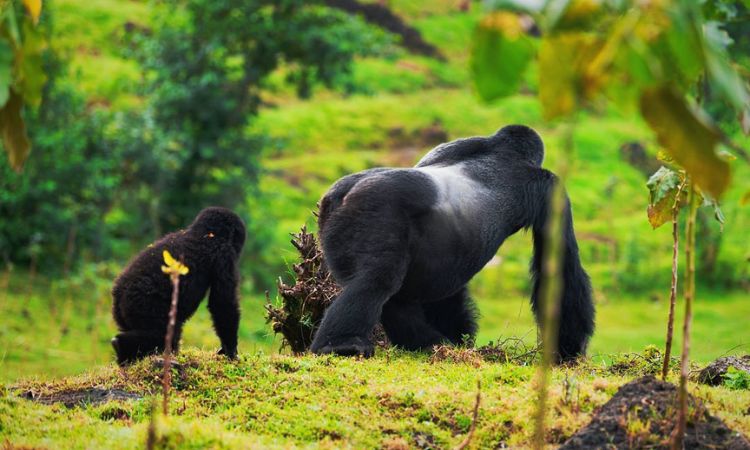
Habitat Loss
Habitat destruction constitutes a paramount hazard to silverbacks and their kin. As human populations expand, there is escalating demand to transform forested areas into agricultural land, residential developments, and infrastructure. This invasion diminishes the habitat accessible to gorilla families and results in habitat fragmentation, compelling groups to inhabit isolated forest areas. This presents an added challenge for the Silverback in identifying secure pathways for foraging and safeguarding his offspring from the perils associated with diminishing areas.
Illegal hunting
Despite its illegality, poaching continues to pose a significant threat. Although gorillas are not generally targeted for consumption, they may inadvertently fall prey to traps and snares designed for different species. The protective instinct of a silverback renders him particularly susceptible, as he frequently positions himself between his family and threats. Injuries from snares can be grave, impairing his capacity to forage, safeguard the group, or uphold his dominance.
Diseases and infections
The disease presents a considerable threat to families led by silverbacks. Mountain gorillas possess around 98% of their DNA in common with humans, rendering them vulnerable to numerous same diseases. Human-wildlife interactions, primarily via tourism or adjacent human populations, elevate the risk of disease transmission, including respiratory diseases. The Silverback, as the leader, is tasked with directing the group to more healthful and secure environments; nevertheless, even his vigilance cannot entirely shield them from these unseen dangers.
Internal Gorilla Group Conflict
Intra-species rivalry may pose an additional obstacle for silverbacks. Conflicts between competing factions, particularly during interactions in contested areas, may result in physical altercations. These confrontations pose a peril to the silverback, as his duty is to protect his family, often at considerable personal jeopardy. An injured silverback may find it challenging to maintain the leadership and protection essential for his family, potentially leading to alterations in group dynamics or even the disintegration of the troop.
What transpires When a Silverback is Lost?
The demise or absence of a silverback significantly affects the dynamics and future of the gorilla troop. The silverback’s absence, as the leader, guardian, and pivotal character in sustaining harmony, might render the family vulnerable and unsure. The subsequent events primarily hinge on the group’s makeup and the conditions surrounding the loss.
The demise of a silverback often results in a power vacuum that must be addressed to guarantee the family’s ongoing survival. If the family has a mature or nearly mature male, referred to as a blackback, he may assume the role of the new silverback. The changeover may be intricate, as the blackback must demonstrate his capacity to command and safeguard the group. The success of this transition frequently hinges on the effectiveness of the prior Silverback’s mentorship of the Blackback. Had the deceased Silverback invested time in developing his successor and imparting essential leadership skills, the organization would have been more inclined to maintain stability during the transition of power.


In the absence of an appropriate successor within the group, the family encounters heightened uncertainty. In the absence of a silverback, the females and juveniles become increasingly vulnerable to external threats, including assaults by competing males or predators. In certain instances, the family unit may disband, with females and their progeny pursuing alternative groups overseen by dominant silverbacks. This fragmentation can undermine social cohesion and diminish the genetic variety within the gorilla population, adversely affecting conservation initiatives.
Competitive males, primarily solitary individuals referred to as lone silverbacks, may endeavor to usurp the group. Upon this occurrence, the new silverback frequently establishes his authority, which may entail aggressive displays or even infanticide – the elimination of infants fathered by the preceding silverback. Although this behavior may appear harsh, it is a natural method for the new leader to affirm his lineage and guarantee that the family’s resources are allocated to his progeny. This tumultuous era may be distressing for the group, particularly for the moms, although it ultimately results in the reorganization of the social structure under the new Silverback’s leadership.
Notwithstanding these hardships, mountain gorilla families exhibit remarkable resilience. Eventually, a new silverback, either from within the group or an external challenger, can reestablish the stability and order essential for the family’s prosperity. The group’s capacity to adjust and restructure following the demise of a silverback highlights the significance of this position in preserving the fragile equilibrium of gorilla society. It underscores the essential importance of conservation initiatives aimed at safeguarding silverbacks, as their survival is intrinsically linked to the well-being and unity of the gorilla family.
Conservation Focus: Safeguarding the Silverbacks and Their Family Members
The conservation of mountain gorillas, especially the silverbacks that are fundamental to their familial structures, has remained a continual focus in numerous game parks and reserves throughout Africa. These remarkable beings once teetered on the edge of extinction owing to habitat destruction, illegal hunting, and illness. Their population has favorably increased because to coordinated conservation initiatives, however they continue to be highly endangered. Safeguarding silverbacks and their kin is essential for the conservation of the species overall.
Establishing protected areas, such as Bwindi Impenetrable National Park in Uganda and Volcanoes National Park in Rwanda, has shown to be one of the most effective conservation methods. These parks offer secure environments where mountain gorillas can inhabit and traverse without the imminent danger of human intrusion. Conservation organizations collaborate with local governments to implement anti-poaching legislation and establish buffer zones around habitats, thereby mitigating the risk of illicit activities that could jeopardize gorilla populations.
Tourism, especially gorilla trekking, is essential for financing conservation initiatives. The income earned from hiking permits is returned into the parks, supplying resources for anti-poaching patrols, veterinary services, and community development initiatives. These programs are meticulously regulated to mitigate human effect on the gorillas, according to stringent standards for visitor numbers, trip duration, and distance from the gorillas to diminish the danger of disease transmission. This sustainable tourism strategy enhances awareness and offers local populations economic incentives to save gorilla habitats.
An essential component of conservation initiatives is the surveillance and management of gorilla families. Conservationists and researchers often perform field observations to monitor the movements, health state, and social groups of silverbacks. When a silverback or any group member sustains an injury or becomes ill, veterinary teams referred to as Gorilla Doctors intervene to administer medical treatment. These treatments have been essential in controlling illness outbreaks and addressing injuries inflicted by snares, directly enhancing the survival and welfare of the gorilla population.
Conservation initiatives also involve local communities, acknowledging that the survival of mountain gorillas is contingent upon the individuals inhabiting their ecosystem. Educational and community-oriented efforts seek to foster cooperation, mitigate human-wildlife conflict, and offer alternative livelihoods that diminish the necessity for practices such as deforestation or poaching. By engaging local communities in conservation initiatives, these programs foster a sense of stewardship and collective accountability for the protection of gorillas.
The efficacy of these conservation initiatives is most evident in the population and vitality of the silverbacks. The conservation of gorilla families, as their keystone, guarantees the survival of the larger population. When silverbacks flourish, they guide their families through the woodlands, nurture the offspring, and transmit the knowledge vital for the group’s survival. Consequently, the current efforts to protect mountain gorillas are, in numerous respects, a quest to maintain the Silverbacks’ vigor, sagacity, and heritage.